TRUE MPS/MRP · CONNECTED FACTORY EXECUTION
End-to-end manufacturing ERP/MRP focused on production planning and execution efficiency
Strategic ERP/MRP connects Sales, Forecasting, Purchasing, Warehousing, Production, Quality, Packing, Costing, and Accounting through a single set of factory data, with True MPS/MRP at the core of decision-making
✓วางแผนเร็วขึ้น ✓ ลดคอขวด ✓ ลดงานล่าช้า

20 + ปีแห่งประสบการณ์ Manufacturing Software
Real MPS/MRP คำนวณตามหลักการ และนำไปใช้กับโรงงานจริง
Visual เห็นแผนและ
ความเสี่ยงทันที
Thai Team พัฒนาและดูแล
โดยทีมในประเทศไทย
WHAT IS STRATEGIC ERP/MRP?
Strategic ERP/MRP
Manufacturing ERP/MRP Software manages the entire flow—from Sales and Forecasting through Purchasing, Inventory, Master Production Scheduling and Material Requirements Planning (MPS/MRP), Production, and Barcode/QR Code Validation to Quality Control, Packing, Delivery, Outsourcing, Production Monitoring, Costing, and Accounting—so every department works from the same data.
Strategic ERP/MRP is a complete manufacturing ERP/MRP system built around true production planning through Master Production Scheduling and Material Requirements Planning.
It answers the key questions every factory must address: What should be produced, in what quantity, which raw materials are required, and when should production begin? It also generates recommendations for Purchase Orders and Work Orders based on actual requirements for each time period.
The system connects planning with execution through Barcode/QR Code Validation, Shop Floor Control, Real-Time Quality Control, Production Monitoring, Lot Traceability, and Costing, ensuring that the production plan is reflected in verifiable actual results.
THE REAL FACTORY CHALLENGE
Factories are not short of systems.
They are short of a plan that every department can trust and follow.
When Demand, BOM, Stock, WIP, Purchasing, Production, and QC are not connected, one error can quickly turn into expediting, excess inventory, overtime, and company-wide delivery risk.

ERP for manufacturing generally follows one of two approaches:
1. Transaction ERP
2. True ERP/MRP
The key difference is whether MRP Theory is used as the engine that drives planning and supports decision-making.
A good ERP/MRP system should enable the organization to operate continuously from production and material plans calculated from real factory data.
MPS (Master Production Schedule) creates the master production plan.
MRP (Material Requirements Planning) calculates:
- Which raw material Item Code is required
- How much is required
- When it should be ordered
- When it should arrive or be available for use
A good ERP/MRP system also keeps raw materials, work in process, and finished goods at appropriate inventory levels—not so high that capital is tied up, and not so low that production is disrupted.
On the Shop Floor, the system prevents errors by validating the Barcode/QR Code of each Item, Lot, Work Order, and production step.
It also provides Quality Control capabilities that immediately determine whether work has passed or failed the required quality criteria.
Real-Time Production Monitoring gives every department a shared view of the latest production plan and progress.
Lot Traceability enables the factory to trace materials from their origin, through the production process, to finished goods and delivery, together with other tools for factory management.
The result is more accurate planning, better-balanced inventory, fewer errors, immediate visibility into quality and production, and more effective cost control.
Interested in a True ERP/MRP System to improve your factory's operational performance?


THE PROOF OF TRUE MPS / MRP
A true ERP/MRP system must accurately calculate production plans and raw material purchasing requirements through MPS/MRP.
It must also support production execution so customer orders are delivered on time while factory inventory remains at the right level—not too high and not too low.
To achieve this, an ERP/MRP system must perform real MRP calculations, generate genuine MRP schedules, and make those plans actionable across every department in the factory.
ERP FACTORY SOFT CO., LTD.
We guarantee the quality of the Strategic ERP/MRP System and our factory implementation services.
Interested in implementing an ERP/MRP System?
Contact us: 089-0035991
Strategic ERP/MRP MRP Table Compared with SAP and Oracle MRP Tables


ตาราง MRP ของ Strategic ERP/MRP

SAP Software MRP Table

Oracle Software MRP Table

Stategic ERP/MRP System Flow Daigram
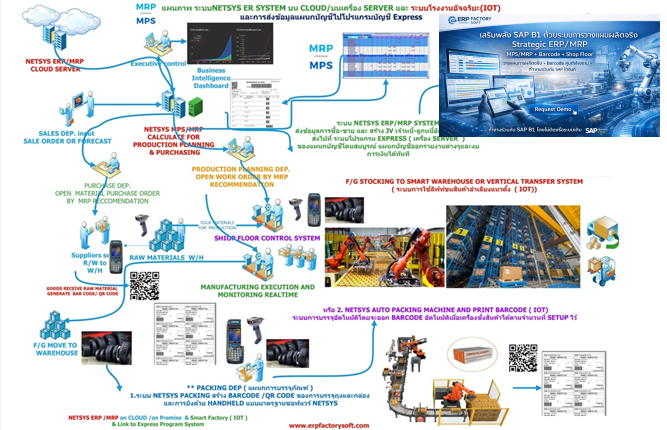
Illustration of Gross Requirements Calculation in the MRP Table

CORE CAPABILITIES
Core capabilities that connect every department through one shared plan
Designed for planners and executives who need to make decisions based on real operating conditions
It is more than a report of what has already happened.
01

Sales & Forecast
02

Real MPS/MRP
— Time-Phased Planning
03

Purchasing & Supplier Management
04

Inventory & Warehouse Management
05

Barcode / QR Code Validation
06

Work Order & Shop Floor Control
07
Real-Time Quality & Production Monitoring
08
Out-Sourcing Control
09
Packing, Shipping & Lot Traceability
10
Costing Management
11
OEE & Management Dashboard
Accounting & Existing ERP Integration
FROM TRANSACTION TO FACTORY-WIDE PLANNING
How is Strategic ERP/MRP different?
From an ERP that only creates Work Orders to a true ERP/MRP system that calculates MPS/MRP plans
It produces actionable plans and Work Orders that answer: “What should be produced or purchased, and when?” so the factory can operate efficiently and avoid disruptions.

Transaction-Focused ERP for Transactions and Work Order Creation
Advantages when it fits the context
It is easy to start with, has straightforward procedures, and provides good control of sales, purchasing, inventory, and Work Order documents. It may be suitable for factories with a limited product range, simple BOMs, and infrequent plan changes.
01 Work Orders can be created, but there is no underlying plan
Users must decide for themselves what to produce, how much to produce, and when to start. The Work Order may not be connected to the factory-wide demand plan.
02 MRP calculations are basic
The system may calculate only Demand minus Stock, without fully exploding a multi-level BOM or considering Lead Time, Safety Stock, Lot Size, and time-phased requirements.
03 Supply and demand are not fully netted
Open POs, Work Orders, WIP, and Scheduled Receipts may not be included in one integrated calculation, creating a risk of duplicate purchasing, overproduction, or shortages when materials are needed.
04 Purchasing and planning depend on manual checking
Purchasing staff and planners must check Excel files, stock balances, and documents across multiple sources. They may know how much to buy, but not exactly when to place the order to support production on time.
05 Each department may be working from different data
Sales, Planning, Purchasing, Warehousing, and Production pass information through Excel, phone calls, or messages. When the data changes, the plans used by other departments may not change with it.
06 Plan adjustments depend on individuals
Planners must remember a large number of conditions. When an order changes or materials are delayed, they must revise the plan manually, making continuity dependent on the experience of a few individuals.
07 Problems become visible only after they occur
Inventory and WIP may be high while critical materials are still missing, leading to expediting, overtime, waiting time, and delivery risks that management sees too late.

Driven by True MPS/MRP
Strengths when the factory is ready to grow
It connects Demand, Materials, Purchasing, Production, and actual shop-floor results to create verifiable recommendations and enable every department to work from one shared plan.
01 Start with verifiable Demand
Combine Sales Orders and Forecasts into product-level demand by quantity and time period, with rules to prevent duplicate demand according to the organization’s operating practices.
02 Calculate True MPS/MRP using time-phased planning
Distribute demand through a multi-level BOM and calculate requirements for Finished Goods, Subassemblies, Components, and Raw Materials by time period, based on MRP Theory.
03 Consider all statuses and planning rules
Calculate together with On-Hand Inventory, Safety Stock, WIP, Open POs/WOs, Scheduled Receipts, Lead Time, Lot Size, and Yield to determine actionable Net Requirements based on MRP Theory.
04 Produce purchasing and production plans with release dates
Show Planned Order Receipts and Planned Order Releases so users know what to purchase or produce, how much is required, when it is needed, and when action must begin.
05 Create Work Orders from the actual plan
Generate recommendations and create Work Orders for multiple Items and Lots from MRP results, verify Material Readiness before confirmation, and then pass them to the Shop Floor.
06 Every department works from one shared plan
Sales, Planning, Purchasing, Warehousing, Production, and management see role-based information from the same Demand, Plan, and Transaction data.
07 Plans connect back to actual results
Barcode/QR Code, Shop Floor, QC, Outsourcing, Packing, Monitoring, OEE, Traceability, and Costing feed actual shop-floor results back into decision-making.
THE RIGHT SYSTEM MUST FIT THE FACTORY
It is not enough to create a Work Order.
The system must also know “what should be created, in what quantity, and when.”
This is what enables efficient production and factory control without unnecessary disruption.
A transaction-based ERP is not wrong when it matches the complexity of the factory. However, when there are multi-level BOMs, many products, multiple Lots, different Lead Times, and frequently changing Demand, the factory needs a true MPS/MRP system that can perform real calculations and show where each requirement comes from.
FROM DEMAND TO DELIVERY
Strategic ERP/MRP
One connected plan—from Sales to Accounting
Actual data from Warehousing, the Shop Floor, QC, and Packing flows back into MRP, Monitoring, Costing, and Dashboards, keeping the plan connected to the factory’s reality.
BUSINESS OUTCOMES
Higher performance must be measurable across the entire factory
The value of ERP/MRP is not the number of screens. It is lower costs, more reliable delivery, standardized work, and the management time recovered for higher-value decisions.
1. Reduce Inventory and Tied-Up Capital
Produce and purchase according to accurate MRP calculations that reflect actual operating conditions, rather than buying extra stock because the requirements have not been calculated correctly.
2. Reduce Material Shortages and Expediting
See what will be needed before production starts, together with release dates based on Lead Time.
3. Reduce WIP, Overtime, and Expediting
Every department works from the same priorities and plan, with visibility of abnormalities before they affect delivery.
4.Raise Work Instruction (WI) Standards
An MPS/MRP system that coordinates the entire organization through one plan, together with Barcode, Routing, QC Checklists, and approval rights, records standardized work methods in the system.
5. Reduce the Time Required to Create and Adjust Plans
Planners no longer need to consolidate and revise multiple Excel files. The system calculates requirements and generates production and purchasing recommendations from one shared dataset.
Measurable KPIs: Planning preparation time, plan adjustment time, and planner workload hours
6. Improve Capacity Utilization
Plans, materials, Work Orders, and machine status are connected, reducing material waiting time, idle machines, and underutilized capacity.
Measurable KPIs: Machine Utilization, OEE, Production Output, and Downtime
7. Reduce Errors with Barcode/QR Code Validation
The system validates the Item, Lot, Location, Work Order, Process, and quantity before a transaction is confirmed, preventing incorrect picking, production, or packing at the point of work.
Measurable KPIs: Inventory Accuracy, Picking Errors, Production Errors, and Packing Errors
8. Improve Quality Control and Make Faster Decisions
Check quality from incoming raw materials, through production, to finished goods, with PASS/NG results and real-time notifications for the responsible teams.
Measurable KPIs: Reject Rate, Rework Rate, First Pass Yield, and QC issue response time
9.Keep Outsourced Work on Plan
Track work sent for plating, coating, or external processing from Send-Out, Supplier, Lot, and Quantity through Due Date and return to the production line.
Measurable KPIs: Outstanding outsourced work, late returns, quantity losses, and Supplier On-Time Delivery
10. Improve Capacity Utilization
Plans, materials, Work Orders, and machine status are connected, reducing material waiting time, idle machines, and underutilized capacity.
Measurable KPIs: Machine Utilization, OEE, Production Output, and Downtime
11. Respond to Customers and Confirm Plans Faster
Sales staff can check material status, production plans, Work Orders, and actual progress without calling multiple departments.
Measurable KPIs: Customer response time, Order Confirmation Time, and the number of delivery-date changes
12. Preserve Factory Knowledge in the System
กติกา MRP, BOM, Routing, Lot Policy, WI, QC Checklist และ Approval Workflow ถูกจัดเก็บเป็นมาตรฐาน ลดการพึ่งพาพนักงานเพียงบางคน
KPI ที่วัดได้: ระยะเวลาฝึกพนักงานใหม่, จำนวนข้อผิดพลาด และเวลาส่งต่องาน
13. ส่งมอบได้มั่นใจขึ้น
Sales, Planner , จัดซื้อ และ Production เห็น Due Date, Material readiness และความคืบหน้าชุดเดียวกัน
14. รู้ต้นทุนที่เกิดขึ้นจริง
คำนวณต้นทุนการผลิต และรับรู้แบบ Real-Time
15. Audit และ Traceability เร็วขึ้น
สืบจาก Customer Lot ย้อนถึง Work Order, Process, QC และ Raw Material Lot
16. สร้างมาตรฐานให้องค์กร ผู้บริหารมีเวลาไปสร้างการเติบโต
ลดเวลาประชุมไล่ข้อมูลและดับไฟ เพื่อโฟกัสลูกค้าใหม่ ผลิตภัณฑ์ใหม่ และการปรับปรุงธุรกิจ
17. ปรับปรุงกระแสเงินสดและเงินทุนหมุนเวียน
ลดการซื้อเร็วเกินไป ลดสินค้าคงคลังที่ไม่จำเป็น และเปลี่ยนเงินทุนจมให้กลับมาใช้กับกิจกรรมที่สร้างรายได้
18. ป้องกันปัญหาก่อนกระทบการส่งมอบ
ระบบ คำนวณ Material Shortage, Order เสี่ยงล่าช้า, QC NG, Outsource เกินกำหนด และความผิดปกติของการผลิต
19. วัดความแม่นยำของแผนเทียบกับผลผลิตจริง
เปรียบเทียบแผนการผลิตจาก MPS/MRP กับผลที่เกิดขึ้นจริง เพื่อให้รู้ว่าแผนกหรือกระบวนการใดไม่สามารถทำงานได้ตามแผน และนำข้อมูลกลับมาปรับปรุงการวางแผนรอบต่อไป
KPI ที่วัดได้: Production Plan Attainment, Schedule Adherence, จำนวนครั้งที่ปรับแผน และ Plan vs Actual Variance
20. รองรับการขยายโรงงานอย่างมีมาตรฐาน
เมื่อองค์กรมีสินค้า เครื่องจักร พนักงาน หรือสาขาเพิ่มขึ้น ระบบยังใช้ Master Data, Process และมาตรฐานการควบคุมร่วมกันได้
การใช้ BARCODE ในการ Validate การใช้วัตถุดิบและเดินการผลิต
อย่าเพิ่งเชื่อว่า ERP/MRP ระบบใดเหมาะกับโรงงานของคุณ
จนกว่าจะได้ทดลองระบบด้วยข้อมูลโรงงานท่านเอง
ส่งตัวอย่าง Order, Routing, Machine Capacity, WIP และ Due Date ให้ทีมงานของเราวิเคราะห์
แล้วดูว่า Strategic ERP/MRP จะช่วยให้คุณได้อย่างไร
FREQUENTLY ASKED QUESTIONS
คำถามก่อนเริ่มต้น
Strategic ERP/MRP
คำตอบเหล่านี้ช่วยให้ทีมบริหาร วิศวกร และ Planner ประเมินทั้งหลักการ MRP, หน้างาน, Integration และแนวทาง Implement ก่อนตัดสินใจลงทุน
LET'S SEE YOUR FACTORY CLEARLY
เริ่มจากปัญหาจริง
ของโรงงานคุณ
เล่าโจทย์ให้เราฟัง ทีมงานจะช่วยวิเคราะห์ว่า ERP/MRP, APS, SAP B1 Integration หรือ Smart Factory & IoT ควรเริ่มจากจุดใด
Tel : 0890035991
sales@erpfactorysoft.com
WEBSITE
www.erpfactorysoft.com

SOLUTIONS
Strategic ERP/MRP
Strategic APS
SAP Business One Integration
Smart Factory & IoT
COMPANY
About Us
Business Results
Contact
CONTACT
sales@erpfactorysoft.com
www.erpfactorysoft.com